-
Community solar on warehouse roofs
Here’s one that’s practically a no-brainer, if we can figure out a few regulations and simplify the payment model: cover all the giant warehouses with solar panels. US warehouses alone have an estimated 16.4 billion square feet of rooftop space, and that’s not counting strip malls, office buildings, etc. Nobody’s going to complain about how it looks, and nobody’s going to make up stories about poisoned potatoes. Set up the incentives the right way, and warehouse owners will be clamoring for it.
-
Big bus batteries boost the grid
How cool is this? In Massachusetts, parked EVs will start feeding the grid this summer.
The three [electric school buses] will charge up their nearly 200-kilowatt-hour batteries overnight, when the power supply is at its cleanest and cheapest, then send energy back to the grid from 4 p.m. to 7 p.m. on days when the grid is strained. The district will earn revenue for the power it shares, perhaps even enough to cover the costs of charging up during the school year, said Kate Crosby, energy manager for the Acton-Boxborough school district. Plus, the strategy will help lower the emissions and cost of the region’s electricity supply.
It’s a pilot program, being used to find and work through whatever barriers there are to deploying this kind of approach more widely. But surely just that paragraph quoted above shows the potential wins here! And it’s almost a footnote at the end of the article, but shuttling kids to and from school without gassing them with diesel fumes is huge.
One of the hurdles is, of course, the cost: “a long-term, reliable compensation plan is needed to get any meaningful number of EV owners to make the leap”. And that can get complicated with the structures currently in place, as the article details. This is why sci-fi energy/climate solutions are so frustrating: stop blowing money on nuclear or geoengineering or “carbon capture” boondoggles! Spend it on stuff like this! Even if it didn’t pay itself back – which these absolutely will – it would be worth it. We have the technology. Right now, today. We just need the will to make it work.
-
Solar contaminating potatoes? Nope
Here’s a new one: anti-solar folks are making up nonsense about how if farmers allow solar panels on their fields – in this case, potato fields in particular – they’ll ruin that land forever, oh my god, say it isn’t so.
Well, it isn’t so. It’s in the same vein as the “offshore wind farms hurt whales” bullshit. It’s pure fantasy, per this writeup from Canary Media, In new attack on solar, lawmakers spread myths about potato farms. For one, the purported danger is shards of material that might be left behind after the panels are removed. So right off, that’s like thirty years down the road. Hardly some imminent danger. And as for the question of foreign objects or contaminants on the field, it just seems silly. There’s never trash that blows in, or leaked oil from machinery? Not to mention whatever poisons they use as pesticides. Spare me.
Anyway, it’s all baloney. If anything, solar panels probably help crops grow under and in between them. This kind of FUD will seem funny in another few years.
-
Solar booming despite Trump
The proof continues to mount that clean energy, solar in particular, is an economic no-brainer: Why Solar Power Is Booming Under Trump.
Despite the Trump administration’s pivot away from renewable energies, solar continues to dominate new energy additions in the United States. Newly released data from the Federal Energy Regulatory Commission (FERC) shows that at the close of last year, solar energy additions were the single largest form of new energy capacity installations for the 28th straight month, starting in September of 2023. In fact, in spite of a broad rollback of Biden-era clean energy incentives since Trump resumed office in January of last year, renewables represented a whopping 88 percent of energy additions in 2025, with utility-scale solar alone counting for 72.6 percent of U.S. electricity additions.
The author refers to a “pivot away from renewable energies”, and later “a policy climate that is considerably cooler for solar photovoltaics”, but to me that’s pulling punches. The Trump administration is overtly – to the level of illegality in all the cases that have gone to court – hostile to clean energy. Further, they’re pouring millions into propping up the dirty, ugly coal industry, from mining the stuff to burning it for power. Yet solar continues to grow!
Which is great, but imagine how it could have been. If these greedy fossil-fuel monsters weren’t able to have things their way, think of how much faster this transition could be going. Solar being “88 percent of energy additions in 2025” is great, but it should be 100%, and it should be even larger absolute numbers. Still, this is good news for what it says about the clean energy growth even under a hostile regime. Elsewhere, and, one hopes, in a future United States, acceleration will continue.
-
World's largest iron-air battery
Really interesting developments are happening in battery technologies. One alternative to the lithium-ion battery that we’re all familiar with from our phones, laptops, and EVs is iron-air technology. This is the specialty of Form Energy, who just agreed to a deal with Google for a giant energy-storage facility in Minnesota. Lithium-ion is great, and a key technology that continues to come down in cost as it continues to be deployed all over the place. But it doesn’t have the long-term ability that iron-air does:
While lithium-ion batteries are effective for 4-hour shifts, they cannot handle the multi-day storage. Form Energy said its iron-air batteries can store renewables-sourced electricity for 100 hours at system costs competitive with conventional power plants.
The technology itself is fascinating: the energy is actually stored in rust, which can then be de-rusted:
The iron-air battery is composed of cells filled with thousands of iron pellets that are exposed to air and create rust. The oxygen is then removed, reverting the rust to iron. Controlling this process allows the battery to be charged and discharged.
The technology is less energy-dense than its lithium-ion counterparts, making it a better fit for large grid-scale applications. Form Energy said an individual battery module is about the size of a side-by-side washer/dryer set and contains a stack of approximately 50 one meter-tall cells. The cells include iron and air electrodes, the parts of the battery that enable the electrochemical reactions to store and discharge electricity. Each of these cells are filled with water-based, non-flammable electrolyte, like the electrolyte used in AA batteries.
This is the kind of thing that research and government support dollars should be going to (as opposed to, say, continuing to prop up the dirty, ugly coal industry).
-
On the Rube Goldberg machine of fossil fuel production
This newsletter from Bill McKibben, from a few months ago (shortly after the US began its illegal war on Iran) makes such a good point. Rube Goldberg’s machines were comically silly, but the tremendous complexity, expense, and risks of the real-world fossil fuel extraction, delivery, and usage systems are deadly serious.
I’ll quote a chunk of it here, but the full details are well worth a few minutes of your time.
If you want a gallon of gas for your car, someone first needs to have drilled for oil—in a few places (Saudi Arabia) this is still relatively easy, but increasingly it means figuring out how to go a mile beneath the surface of the sea, or frack the subsurface geology, which is to say blow it apart. Once you’ve collected your crude, you need to carry it to a port, often through a pipeline that must cross mountain and desert, and there load it on to a giant ship, which must sail the seas. Upon arrival somewhere, it needs to be piped to a refinery, which is among the most complicated pieces of machinery known to man. There it must be separated by heating in a distillation column, so that the light products—gasoline—rise to the top, and heavy products—say, asphalt—sink to the bottom. You use heat and pressure and chemical catalysts to “crack” some of the heavier molecules into lighter, more valuable products, and then you treat what you’ve got to remove impurities like sulfur. You pipe it part of the way to its final destination, and load it into trucks for delivery to gas stations, where it is stored in underground tanks, until someone appears with a credit card to pump it into his vehicle. In the engine of the car it is mixed with air inside a cylinder and compressed; a spark plug fires, forcing a piston to move; this linear motion is converted by a crankshaft into rotational energy to move the car; meanwhile the piston pushes out the burned gases.
The point is that continuing to depend on that dirty, dangerous way of powering our lives, when we can literally get energy freely, cleanly, and quickly from sunlight (and wind) just about anywhere on the planet, is crazy.
-
Cleaner air with EVs measured
The focus of cleaner technologies like electric vehicles is usually on reducing greenhouse gases, which is, indeed, super important. But don’t forget that burning stuff for energy also creates plain old dirty, unhealthy air. So when enough people switch away from old-fashioned gas cars in an area, there should be a measurable improvement in air quality, right? The answer is yes, per recent research:
The study, just published in The Lancet Planetary Health and partly funded by the National Institutes of Health, adds rare real-world evidence to a claim that’s often taken for granted – that EVs don’t just cut carbon over time, they also improve local air quality right now.
They correlated California Dept. of Motor Vehicles EV registrations with satellite data showing nitrogen dioxide (NO2) pollution.
“We’re not even fully there in terms of electrifying, but our research shows that California’s transition to electric vehicles is already making measurable differences in the air we breathe,” said lead author Sandrah Eckel, PhD, an associate professor at the Keck School of Medicine. …They also saw the expected counterexample: neighborhoods that added more gas-powered vehicles experienced increases in pollution. The findings were then replicated using updated ground-level air monitoring data dating back to 2012.
This is why you, me, and everyone should switch to EVs, and why infrastructure like charging stations is worth investing in, and yet another way the Trump administration is undermining public health (by halting the Biden-era EV rebates).
-
McKibben on Trump's anti-wind mania
Climate hero Bill McKibben has a grade-A rant about the stupidity of the Trump administration. In particular – one has to narrow down which of the myriad idiotic, corrupt, and damaging things one is criticizing these people for – he has choice words about Trump’s foolish anti-wind-power mania. I mentioned some of this recently, but Bill’s the perfect voice for this. Well worth reading in full, but here are some choice quotes (emphasis added).
I’m dedicating this newsletter to the topic of wind, because I think it distills the corruption and irrationality of our sad moment into its purest essence — 190-proof Trumpism, the stuff that blinds you if you guzzle it.
…To say that the national security grounds are bogus is to give them too much credit. As those radicals at the Financial Times explained, the security review used to take a “few days” to complete. These installations are on private land, far away from military bases. The government has used the same argument to try and block offshore wind farms, and the courts have overruled their objections.
…That this is stupid goes without saying. Those blocked projects constitute, the [Financial Times] says, about 30 gigawatts of cheap clean energy at a time when we desperately need it. But it also goes without saying that the blockage serves two purposes. One is to artificially increase demand for fossil fuel (and the other Trump-favored power sources, like the expensive array of nuclear reactors whose development the government is currently generously funding). The other is to serve his febrile rage at the wind farm built off his Scottish golf course all those years ago. A policy that feeds both his appetite for corruption and supplies his narcissistic hunger—well, that’s a twofer that can’t be missed.
Beyond the rant, there’s also good news. One area is “repowering” older wind farms: upgrading them with the latest, biggest turbines. This avoids a lot of the permitting, connectivity, and potential obstruction that can face new projects. There also continue to be advances in protecting birds from wind turbines. We love birds, and we don’t want them to be hurt by these things, so that’s great. That said, McKibben makes the crucial point that this downside of wind power is vastly overblown: “To be clear, wind turbines never come within an order of magnitude of avian destruction compared with tall buildings and power lines, not to mention domestic cats, not to mention the effects of climate change now setting off a generalized extinction crisis on this earth.”
Great stuff, as always, so go read it, and subscribe to his excellent newsletter while you’re there.
-
Thanks to Trump, mercury is surging back
From the New York Times, another story to keep in mind when the Trump administration tries to describe coal as “clean” or “beautiful” (or trots out their stupid little mascot, “Coalie”): As Coal Rebounds, More Toxic Mercury Is in the Air (gift link).
Coal-fired power plants across the country released more mercury last year as power demand surged, reversing a yearslong downward trend in the emissions of a toxic metal that impairs brain development.
Mercury emissions from coal-burning plants increased by roughly 9 percent in 2025, compared with a year earlier, totaling more than 4,800 pounds, according to a New York Times analysis of data collected by the Environmental Protection Agency.
At the same time, the Trump administration launched a series of moves that experts say may make those emissions climb even higher this year and beyond.
Please remember: mercury is an extremely dangerous toxic pollutant. The Mad Hatter from Alice’s Adventures in Wonderland was “mad” because of mercury poisoning. Maybe he would be a better mascot for coal than Coalie? Anyway, this shit is bad:
A potent neurotoxin that settles into waterways and accumulates in the food chain, particularly in fish, mercury can cause premature cardiovascular mortality in adults. In children and fetuses, it can cause developmental delays and permanent I.Q. deficits.
Meanwhile, the Trump toady in charge of the EPA says the quiet part out loud.
And Mr. Zeldin has argued that tougher limits on mercury pollution would have regulated the coal sector “out of existence,”
Yes, you crooked son of a bitch, coal should be regulated out of existence! It already has been, in many countries. It’s filthy, inefficient, and now more expensive than clean, renewable (even – dare I say it – beautiful?) energy sources like solar (and batteries, and wind).
Besides which, the economics are so bad for coal plants that the Trump administration is ordering a bunch of them to stay open even though they were already scheduled to close. So it’s costing people more, contributing to climate change, and poisoning everything with mercury (among other toxic chemicals). We have to stop this.
-
Trump admin blocking Texas wind projects
The Trump Defense Department is now using their bogus “security concerns” schtick to block onshore wind development. According to the Texas Tribune, that includes 54 wind projects in Texas.
“It’s not clear why these policies are being implemented during an affordability crisis, but I think it shows the level of disdain the administration has for renewable energy in general and wind power specifically,” said University of Texas energy professor Michael Webber.
As noted previously on this blog, this particular scare-mongering obstructionism is based on plain old bullshit. Like, legally:
Last year, the administration suspended leases for five major projects off the East Coast, citing national security concerns related to radar interference. Federal judges later ruled against the administration in all five cases, finding that the government exceeded its authority and failed to prove that the projects posed national security threats. All five projects have since resumed construction.
If there had been the slightest merit to the “security concerns” raised previously about the offshore wind projects, then at least there could be a pretense for this expansion. But there hasn’t been any merit! There never was!
Dear Texas, Trump is messing with you, which I understood to be something that was frowned upon. Can we get some lawsuits going here?
-
Good ol' Lloyd Doggett gets it
Lloyd Doggett (and some other guy who isn’t my representative in Congress) in an opinion piece for The Guardian: The Iran war reminds us: we’ll never be energy-independent with fossil fuels.
Efforts like the Hromada Project, which is named after the Ukrainian term for “community”, will be essential in helping Ukrainians weather the war by connecting local nongovernmental organizations in Ukraine to public- and private-sector support from around the world.
That’s exactly what our government should be doing: helping communities around the world be more energy secure and independent, sourcing their power locally with renewables, storing energy in batteries for backup, and electrifying everything to make the transition seamless. That’s certainly what is happening in China, which has dominated the global wind, solar, battery and electric vehicle markets as a result.
-
Apartment A/C batteries: simple & fast demand reduction
From AP, a story that shows an easy and effective way to reduce peak demand: give renters with window unit air conditioners a remote-controllable battery.
“It’s basically a souped up version of the power bank that you would use to charge your phone when you go out,” said Andrew Wang, the chief executive officer of Every Electric, the company behind the pilot, which has partnered with [New York City’s] energy company Con Edison.
The devices, about the size of a microwave, charge when electricity demand is low and then run window AC units for a few hours when demand spikes.
This particular approach doesn’t solve everything, but it’s a great example of the kind of simple innovation that could be quickly deployed, at modest cost, and make a big difference. We don’t have to wait for big, uncertain bets like nuclear, or even for the time and expense of giant clean energy projects. This kind of adaptation can happen as fast as anyone – companies, governments, nonprofits, hyperscalers, whoever – can throw money at it.
-
EVs: huge in Costa Rica
New York Times: These Countries Embrace E.V.s to Avoid Oil Price Shocks
Costa Rica is a leading example of how electric vehicles are rapidly gaining popularity in many less affluent countries that are not part of the giant U.S., European and Chinese auto markets. There are signs that the war in Iran, which has sharply raised the cost of gasoline and diesel, is accelerating this trend.
Electric vehicle sales in Latin America, Africa and much of Asia — a grouping that includes billions of people but that analysts often refer to as “rest of world” — soared 79 percent in March compared with a year earlier, according to Benchmark Mineral Intelligence, a research firm. For all of 2025, sales of electric cars in these countries jumped 48 percent.
The article describes growing pains – worries about grid capacity, and some initial struggles with incompatible charging stations – but this is the way forward. These vehicles are just better.
Biusa, a private bus company, is replacing its entire 60-bus fleet with battery-powered models made by King Long, a Chinese brand.
The electric models cost $50,000 more than diesel buses from King Long, but the company can quickly make up the difference by spending less on fuel and maintenance, Miguel Zamora, a Biusa executive, said as he stood near a row of chargers.
The buses easily cover their daily routes on a single charge, he said. Ridership has increased because passengers like the quiet ride and superior air-conditioning.
The buses, Mr. Zamora said, “literally pay for themselves.”
-
Solar's continued US growth
Short article on a recent forecast from the U.S. Energy Information Administration: Solar generation to rise 17% this summer. Solar’s rise continues, as does coal’s decline. Those are both good news! That news is tempered somewhat by seeing both gas and wind stay steady (we want the former to drop and the latter to climb), but under this anti-clean-energy administration we’ll take what we can get.
-
Floating solar: an end-run around NIMBYism
We really have to counteract the anti-solar propaganda, and promote agrivoltaics to dispel the perception of false choice (either farmland or solar, not both). But some folks in Ohio are working on an alternative where they can sidestep those arguments entirely: floating solar panels on reservoirs.
A team of 12 engineers and construction workers are busily connecting more than 3,400 solar arrays to small, floating docks and distributing them across four acres of the reservoir’s surface water.
The electricity generated by the floating photovoltaics will be used to power a nearby water treatment plant, where electricity-powered pumps run 24 hours a day, year-round.
“The water treatment plant is one of the city’s biggest energy costs; it only made sense to put the floating solar site here,” says Sara Weekley, deputy director of Lima’s utilities department.
-
Trump can't stop renewable energy
He’s slowing it, for sure, and that’s tragic, bordering on criminal, in my book. But the switch to clean, renewable energy is unstoppable now. As this Guardian article notes, for the first time, the US generated more power from renewables than gas last month.
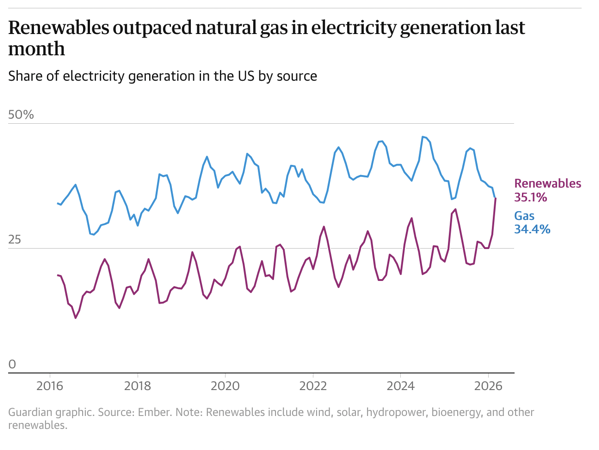
Static image of a nice interactive graph that you should click through to see on The Guardian article. I couldn't resist showing that first crossover point where the purple renewables line exceeds the gas line. Go on, graph! The fight isn’t won yet, of course. Renewables are inevitable eventually, but time is of the essence. Making the switch away from fossil fuels cannot happen quickly enough. The corrupt obstruction of this administration needs to be overcome, and the transition needs to accelerate. But this is still damned good news.
The clean energy industry still has to contend with an uncertain, volatile political environment as well as logjams that delay projects from being connected to a grid that still struggles to move clean power around the country. But fears of Trump-inspired destruction have somewhat receded.
“I’m not nearly as pessimistic as I was last summer,” said Jon Powers, co-founder of CleanCapital, a solar and battery storage company. “The administration way overplayed their hand on this. They are not where the American people are and they’re having to come back to where we are.”
-
DeSantis' Florida is anti-tree-planting, for some jackass reason
Dear Florida voters, please remember the more expensive electricity, the dirtier air, the warmer climate, and the rising seawaters next election, and how your MAGA government made all of that worse just to score a few culture war points and prop up the fossil fuel industry.
Here’s the perfect example: DeSantis signs bill on Earth Day reversing local climate change action.
[offsetting air pollution] can be achieved through cleaner energy or efforts like planting trees that absorb carbon. The new law prevents local governments from passing any “resolution, ordinance, rule, code or policy” that promotes net-zero goals.
That’s Trump’s Republican party for you: heavy-handed government regulation that prohibits local efforts in the name of stopping the unacceptable blight of… [checks notes] clean energy and tree-planting.
-
Energy expert says oil is over
Comments by ‘world’s leading energy economist’ underscore that some folks are, indeed, learning some good lessons from the oil crisis caused by the U.S. and Israel’s attacks on Iran. The Guardian has the exclusive: ‘The damage is done’: global oil crisis has changed fossil fuel industry for ever, IEA chief says.
“Their perception of risk and reliability will change. Governments will review their energy strategies. There will be a significant boost to renewables and nuclear power and a further shift towards a more electrified future,” he said. “And this will cut into the main markets for oil.”
I don’t love nuclear in there, though existing plants are better than fossil fuels, I suppose. He did add that building renewables was an option “I never heard that anybody ever regretted… I don’t see any downsides for renewable energy.”
Ed Matthew, the UK director of the thinktank E3G, said: “The only effective path to energy and economic security is homegrown clean energy. All political parties should now be uniting around that mission. Their failure to do so tells you a lot about whose interests they truly represent.”
-
We have to stop burning stuff for power
Sobering news from the American Lung Association, as reported in The Guardian: Nearly half of US children are breathing dangerous levels of air pollution, report warns.
That’s 33.5 million kids being poisoned by bad air. And guess what a key driver is? Climate change, of course! It’s not just a separate problem from dirty air, and it’s not just going to flood us, or roast us, or burn us, or drought us. It’s also directly making air pollution worse:
Several factors contributed to these unhealthy pollution levels, including extreme heat, drought and wildfires which have exposed a growing share of the population to harmful ozone, the report said.
The regions most affected by high ozone levels include south-western states from California to Texas, as well as much of the midwest. This is mainly driven by smoke from Canada’s 2023 wildfires crossing into the US, along with high temperatures and weather patterns that favored ozone formation in 2023 and 2024 – particularly in southern states.
More broadly, the report found that climate change is intensifying ozone pollution by boosting precursor emissions and creating atmospheric conditions such as higher temperatures and lower wind speeds that allow pollutants to build up and ozone to form.
Air pollution is a big problem, as is climate change. And war, and inequality, and oil spills, and etc. The good news is, there’s something that addresses all of these problems at once: solar (and wind, and batteries), of course! The faster we replace fossil fuels with clean, renewable energy production, the better we’ll all be.
And in the nearer-term, we can vote for and support every candidate under the sun (wink!) that opposes the Trump administration. Because they’re literally killing us.
Since returning to office last year, the Trump administration has initiated at least 70 actions to roll back environmental and climate protections. Among them is the loosening of regulations on power plants that limit mercury and other hazardous air toxics.
Other rollbacks include overturning limits on major air pollution sources, disbanding EPA advisory committees on air quality and ending the practice of estimating the monetary value of lives saved by limiting fine particulate matter and ozone while still calculating costs to companies.
-
Data-centers aren't a reason to use more fossil fuels
There are lots of good arguments in this Canary Media editorial by Amory Lovins and Justin Locke: AI: Does not compute. The dirty, expensive, and failing fossil fuel industry are more than happy to ride the panic-driven AI bubble to energy expansion, building out new plants as fast as they can. But that’s a terrible idea, and we shouldn’t allow it. If you want more power in 2026, it has to be clean power. That’s not even an obstacle! It’s the smarter, cheaper, faster way to do it.
As Lovins and Locke put it:
Renewables also offer essential speed. In Sparks, Nevada, the world’s largest solar-powered microgrid continuously powers modular data centers. Solar panels laid on desert ground feed hundreds of second-life electric-vehicle batteries joined to form a superbattery. It was all built in four months and delivers electricity that’s cheaper, quieter, and more reliable than grid power; uses virtually no water; emits nothing; and is even portable. This is what clean, scalable, market-speed power looks like. Gas isn’t it.

It's high time to go solar