-
Polling shows anti-clean-energy BS is working
Sobering opinion numbers from the Pew Research Center on “Americans’ Shifting Views on Energy Issues”:
The share of Republicans and Republican-leaning independents who say the country should prioritize oil, coal and natural gas over wind and solar power has doubled to 71% over the last six years.
I won’t quote extensively; the gist is that respondents generally have shifted away from preferring clean & renewable energy, and toward fossil fuels. This is especially pronounced among Republicans. You can click through if you want to see the rather depressing numbers and charts.
They word all of this very passively, which may be the impartial style that suits an opinion research organization. But presuming that’s the case, they shouldn’t title a section of this article, “Why are views changing on wind and solar energy?”, because they do not even try to answer that question. The answer is very simple: the billionaire class generally, including companies as well as individuals, and the Republican party specifically, have long waged a very concentrated and very well-funded campaign of lies to achieve these very results.
Because – pardon my language – how the fuck could any sensible person, let alone 20% of “Republican/Lean Republican” people, think that solar is “worse” for the environment?! (The 4% of “Dem/Lean Dem” in the same category are equally mystifying, but that number is almost low enough to just chalk up to the uninformed and the fools.) I mean, really. Worse! How??
It’s so tragically comical that I won’t even interrogate it on the merits. There are no merits! This is like a doctor telling an unhealthy, pre-diabetic person with obesity that they should switch from drinking a gallon of soda a day to drinking a gallon of water, and then their crazy (red-pilled, Fox-news-addled, MAGA) buddy convincing them that that would be worse for them. It’s just pure nonsense.
When getting into specific projects, there can be issues to figure out. Land-use by large solar and wind farms, who pays for what and who benefits (i.e., keeping for-profit utilities from ripping off consumers), and so on. But in the big picture, as portrayed by this survey and the people being asked broad questions like “Is solar good or bad?” and “Is coal good or bad?”, anti-clean-energy propaganda is just that. It’s craven, self-serving, for-profit bullshit.
This is the fight: to educate those who need it, and to un-misinform those who have been fed these lies.
Here’s your cheat-sheet if you ever get included in a survey like this:
- Production of wind and solar power: encourage 👍
- Use of electric vehicles: encourage 👍
- Production of nuclear power: discourage 👎
- Oil and gas drilling: discourage 👎
- Coal mining: discourage 👎
-
We Don't Have Time for Fusion
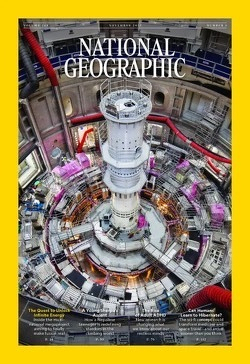 One of the key arguments here at Solar Noon is we don’t have time for that shit, referring to the nonsense that distracts us from the solar future that’s already within our grasp today. Here’s a perfect example: a splashy National Geographic cover story on the giant fusion project “ITER”. The online version of the article, “Inside the long-shot megaproject that aims to solve our energy worries forever” is locked for subscribers (like me, currently), but read on and you won’t miss much. You’re not missing much regardless.
Fusion is that other kind of nuclear reaction, the one that generates energy by atoms smashing together, as opposed to fission, the one that splits them. Fission is what’s used in the nuclear power plants of the past: Chernobyl, Three Mile Island, and Homer Simpson’s Springfield. The magical unicorn promise of fusion is that it has less radioactive waste (but not none!) and can theoretically provide a lot more power.
The key word in that last sentence is theoretically. A lot of smart folks who know about such things aren’t too keen on the whole idea:
Daniel Jassby, who worked at the Princeton Plasma Physics Lab for 25 years, wrote after his retirement that a fusion plant would be too convoluted, requiring endless maintenance, and “cause more problems than it would solve.” The late Lawrence Lidsky, an associate director of MIT’s fusion center and founding editor of the Journal of Fusion Energy, declared after a long career that fusion power is a fantasy, noting that it’s widely regarded as “the hardest scientific and technical problem ever tackled.” Walter Marshall, former chairman of the United Kingdom Atomic Energy Authority, reportedly said that “fusion is an idea with infinite possibility and zero chance of success.”
The entire framing of this article is insane. It’s practically a manifesto of how impractical, complicated, expensive, misguided and crazy this whole project is, but cast in the heroic light of amazement and wonder. Which I suppose is on brand for National Geographic: audacious and amazing and impractical stuff, pictures of rare wildlife, etc. Another article in the same issue is about an 18-year-old who’s climbed the world’s 14 tallest peaks. But the subtitle of this ITER article is, The race is on to harness the near-infinite power of nuclear fusion—by building a star on Earth. And scientists are closer than you might think. Scientists, you learn after reading the whole thing, are actually farther away than you think:
The strange truth of ITER, however, is that it will never produce power. The machine is strictly an experiment to prove that all the steps are achievable. Steam turbines, old technology well understood, will presumably be installed in later generations of fusion plants that will be built all over the world. This step could easily be more than 50 years away.
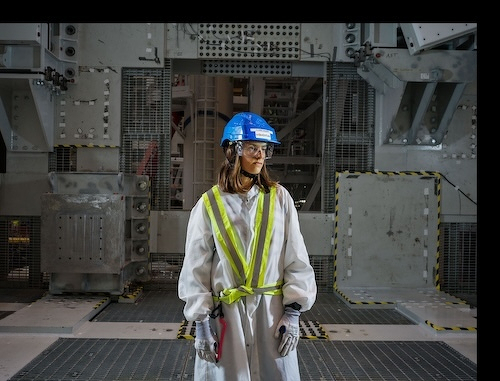
An ITER worker, having just learned that the goal of decades of intricate work and billions of dollars is to run the thing for 400 seconds, if they're lucky Realize, dear reader, that this effort started in 1958. Construction of the facility featured in this article didn’t even start until 2007. In 2022 they made headlines around the world for a huge milestone: installing one – one! of nine! – of the central “vacuum vessel modules” that’s essential to part of the design. Yet that was so badly botched that they had to tear it all out and start over, a mistake that cost them years. At the cost of billions of dollars, of course - though the thing’s been dragging on so long that nobody’s really sure how much total money it’s burned yet (the US Dept. of Energy estimates $65 billion, and counting).
That’s all public money, from countries all over the world (the international cooperation behind this boondoggle is actually a pretty nice story, if surely sanitized in Nat Geo style), but there are also a bunch of private companies trying to crack this nut. Let’s stop pouring taxpayer money into the 270-million degree plasma that will never exist inside this “most complex machine humans have ever attempted to build”. And let’s stop looking to these ‘so crazy it just might work’ long shots.
Fusion, observers like to say, is 20 years away—and always will be.
Meanwhile, as the world outside of Saint-Paul-lès-Durance, France continues to burn, we have the technology right now, today, this minute, to replace fossil fuels with clean energy. Those technologies – solar panels, wind turbines, and battery storage – are all advancing at a fantastic pace, too. Their research and deployment could absolutely use billions of public dollars, and they will start putting out the climate fires immediately. They’re also easily distributable and installable all over the world. Even if there were some magic breakthrough with nuclear fusion and someone figured out how to build these “most complex machines humans have ever attempted” today, how soon do you suppose one of those reactors would pop up in Africa, or Southeast Asia, or Mississippi? It’s ludicrous to suggest this
technologyfantasy has the slightest bearing on “solving our energy worries”, so let’s just not, okay?

It's high time to go solar