-
The Trump Energy Crisis
The miracle of our time is the availability and affordability of electricity from the sun (and wind, and batteries). That may sound hyperbolic, but I really think it’s true. Like it or not, humanity in the twenty-first century requires a lot of energy to support its lifestyle. We got here mostly by burning stuff of one kind or another, with pretty obviously bad impacts on air quality. There’s been some advancement in cleaning that up, but then there’s climate change. Less obvious yet way worse, and the advancements on “cleaning that up” have been woefully slow.
So we need a way to generate a bunch of electricity quickly & cleanly. We could hope for a sci-fi silver bullet, like nuclear fusion, or we could focus on the known, existing, and immediately deployable technologies we have: solar, and wind, and batteries. These have always been cleaner, more independent, and created good jobs. The miracle of our time is that now they’re cheaper, not only to build, but also - especially! - to run in the long term. You don’t need to ship sunlight (or wind) from halfway across the planet, or refine it, or distribute it, or clean up spills of it. The whole energy sector is now as close to a no-brainer as you can get. Yet somehow, the current U.S. administration is doing everything it can to obstruct things.
Almost a year ago, President Donald Trump declared that the United States was experiencing an “energy emergency.” At the time, the U.S. was beating national and world-historical records for oil and gas production, as well as for wind and solar generation. But since then, the threat of an energy emergency really has emerged, in large part thanks to Trump’s own interventions in the power sector.
The Trump administration has blocked construction of renewable power sources, rescinded billions of dollars allocated by Congress to expand the grid and clean energy, and helped pass a law that vaporized federal tax credits for wind and solar projects.
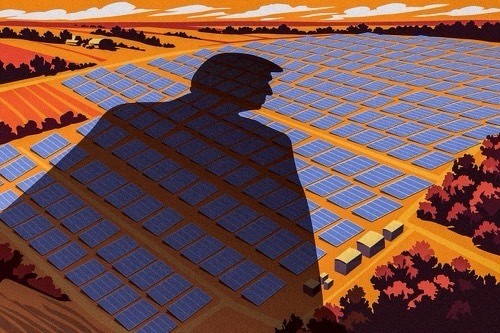
This fucking guy casts his oily shadow over just about everything now. Solar farms are no exception I mean, you have to hand it to the guy, he really can bring problems to life. From rampant corruption in Washington D.C. (aka “the swamp”), to America’s weaker standing on the world stage, to energy emergencies, he’s forever complaining about big problems just before he creates or seriously exacerbates them. On the energy front, that same Canary Media article goes on to list some of the specific actions Trump has taken to manifest this particular crisis:
-
Halting the five offshore wind projects under construction as of December, after unsuccessfully trying to stop two of them earlier last year.
-
Blocking new federal permits for wind farms, a step that a court ruled was unconstitutional.
-
Requiring wind or solar developments on federal lands to obtain a personal sign-off from Interior Secretary Doug Burgum; only one plant has been granted permission by the administration.
-
Canceling final approval for what would have been the nation’s largest solar farm, a 6.2-gigawatt behemoth in the Nevada desert.
-
Eliminating tax credits for wind and solar projects that start construction after July 4, 2026.
-
Revoking billions of dollars appropriated by Congress to support solar installations for low-income communities.
-
Canceling billions of dollars allocated by bipartisan legislation for major upgrades to the power grid, such as the Grain Belt Express transmission line.
The injunctions on those offshore wind projects in the first point have been lifted (for now) after lawsuits showed the obvious: they were spurious and illegal. But that third point, about requiring Burgum’s sign-off, is still keeping tons of potential power in limbo:
Over 22 gigawatts of utility-scale wind and solar projects on public lands have been canceled or are held up as a result of the order, according to Wood Mackenzie data and the Interior’s Bureau of Land Management website. That’s enough capacity to power roughly 16.5 million U.S. homes — a significant amount at any point, but especially when the country is clamoring for more low-cost electricity as energy demand and utility bills soar.
“We’re seeing electricity costs go up all around the country, and the cheapest electrons that we can put into the supply side of that equation are all stuck on Secretary Burgum’s desk,” Sen. Martin Heinrich (D-N.M.) told Canary Media.
This isn’t a bunch of starry-eyed hippies with idealistic dreams. This is electricity generation that simply makes so much sense that the solar (and wind, and batteries) industries are making forward strides in spite of these dumb ideological barriers. Take it from the definitely-not-hippies at the Wall Street Journal and JPMorgan Chase:
Pressure on where to garner energy has shifted with the advent of power-hungry AI. Heather Zichal, global head of sustainability at JPMorgan Chase, said renewables “are vital strategic resources in the race to meet growing energy demand and power AI innovation,” adding that solar “is too cheap and too fast to build to ignore.”
Sun-drenched red states such as natural gas-rich Texas are reaping the benefits of solar. According to a report on the U.S. Energy Information Administration’s website posted in October, the Texas electricity grid is increasingly relying on solar and wind. Utility-scale solar generated 50% more electricity in the first nine months of 2025 than in the same period of 2024—nearly four times as much as the same time frame in 2021, the report said.
Texas! Not exactly a bastion of progressive woke-ism, is it? (And that quote focuses on solar; Texas has tons of wind generation, too.)
So here’s solar (and wind, and batteries), ready to be quickly deployed wherever needed to help bring down electricity prices for all of us (and reduce air pollution, and slow climate change, and give us more energy independence). And then here’s this crook: Trump order to keep Michigan power plant open costs taxpayers $113m. That’s the story of an “aging, unneeded” old power plant, that was on the verge of being retired. Yet against all common sense (not to mention any sliver of the pre-MAGA Republican party’s opposition to the meddling of “Big Government”), the Trump administration has ordered it to keep running. Sorry, Michigan! You just have to eat an extra $615,000 per day for no other reason than Trump trying to prop up the coal industry.
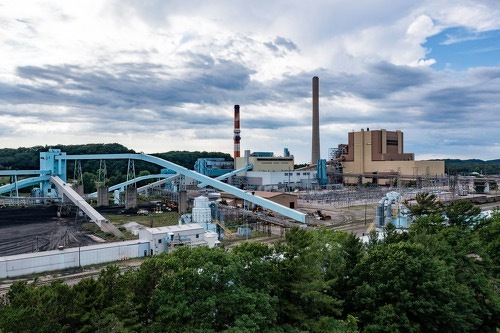
This old coal plant was like, "Just when I thought I was out, they pull me back in!" (Also, please think of the elegant and appealing architecture on display here the next time you hear someone complain that windmills or solar panels are eyesores.) That’s not a weird one-off case in Michigan, either. There’s a similar story in Colorado, where it’s estimated that forcing a broken-down old plant to keep “running for 90 days would cost at least $20 million”. The Trump EPA is, of course, also pitching in to abet this ridiculous scheme, by giving coal plants a free pass on toxic ash disposal:
The move tosses a lifeline to the polluting power plants. If the facilities were barred from dumping ash into unlined pits, they would be forced to close, since they can’t operate if they don’t have a place to dispose of the ash, and the companies say finding alternative locations for disposal would be impossible.
That’s “clean, beautiful coal” for you, as Trump idiotically calls it. Easy for him to say, since he doesn’t have to drink the water that’s contaminated by a devil’s brew of arsenic, molybdenum, cobalt, radium, and god knows what else.
Look, this is classic Trump: pushing bad policies that enrich and empower him and/or his cronies, and to hell with everyone else. But there’s a better, cleaner, and cheaper way. Here’s just one study, for example: Kentuckians could save billions if utilities moved beyond fossil fuels (note that’s billions, with a ‘b’).
“Here in Kentucky, coal was the least-cost way to produce electricity, but as our coal plants age and as the cost of renewable energy continues to fall, that’s simply no longer the case,” Wilmes said. “Continuing to rely on aging, uneconomic power plants simply leads us to less stable, less dependable and higher-cost electricity when compared to the other pathways that are modeled in our report.”
The Biden administration took some great, groundbreaking steps toward accelerating solar (and wind, and batteries). It wasn’t perfect, but it was a good start. Trump feels he has to pit himself against anything Biden was for, and all that fossil-fuel industry campaign money has to be repaid, too. But this particular grift of his is costing all of us, both directly, through higher power bills, and indirectly, through unnecessary air pollution and continuing to pour greenhouse gases into the atmosphere.
I’ll give the final word to Armond Cohen, executive director of the Clean Air Task Force, with a great quote from the first story I linked above:
There is a crisis. It’s like we’re back in the ’70s, but instead of OPEC squeezing us, it’s us squeezing us.
It’s 269 days until Election Day, when we can start putting a stop to some of this nonsense. See you at the polls.
-
-
Agrivoltaics - Win-Win-Win, So Many Wins
The name “agrivoltaics” - a mashup of agriculture and photovoltaics - may be a little clunky, but the idea is as simple as it is brilliant. It’s the combination of the two uses on the same land. Not just crops, or just solar panels, but both, usually striped across the acres. Like a lot about the solar boom we’re watching blow up, it isn’t a new application, but it’s really catching on. And deservedly so: it’s a win for solar, a win for farming, and a win for land-use, each win with more wins within. So many wins!
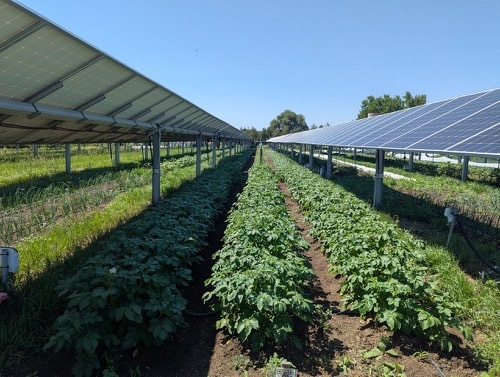
Two crops being farmed at the same time: potatoes and electrons It’s an easier fit for some crops and livestock than others. Lower-growing plants that can do well, or even thrive, without full sun are ideal. Soil temperatures, and therefore water retention, can both be significantly improved by the shade of the panels.
Economic returns are substantial: lettuce revenue can increase by 30%, and tomato revenue can rise by 36% in the Southeast. …Solar panels [in vineyards] in Portugal have reduced irrigation by 30%, improved grape yields by up to 30%, and enhanced quality by 15%.
In partnership with [University of Texas Rio Grande Valley], Fortress Microgrid implemented an agrivoltaic system at the 15-acre Dos Rios Winery, shading grape varieties like Blanc Du Bois and Chardonnay. Solar panels provide power for wine production and tasting rooms, lowering electricity costs while improving grape quality and water efficiency by 20-30%.
One of the objections that some solar projects run into is that they’ll take away land from farming. Agrivoltaics is a wonderful “both/and” response to those concerns. It diversifies income sources for farmers and landowners without making them give up their way of life or livelihood (see also: wind farms and ranchers).
In fact, coming from the other direction, solar farms can provide more agricultural opportunities in some areas, as this article from Wisconsin Public Radio details:
Berry and The Food Group have partnered with US Solar, a Minneapolis solar company, to pilot long-term farming leases for the land inside a solar array. US Solar specializes in community solar projects — arrays that can produce 1 to 5 megawatts of power and cover 8 to 50 acres of land. The project’s emerging farmers get to grow their food crops under the solar panels and in the 20 feet between rows for free.
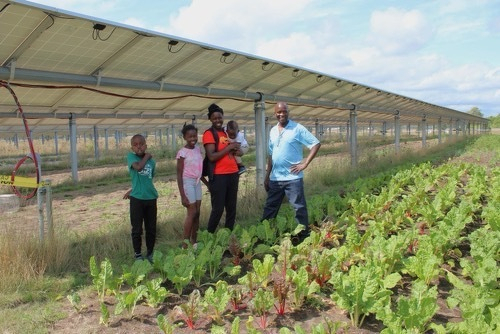
Farmers working with The Food Group, a Minnesota-based nonprofit, are growing organic food at a solar field north of Minneapolis Now, not every solar farm is going to offer use of the land for free. There were upfront costs to ensure “farmers have access to water and electricity, appropriate insurance for their new circumstances, and [allocated] plots”. But for this pilot, US Solar is getting tangible benefits on top of the favorable public relations coverage:
Since the land is being farmed, the solar company doesn’t have to pay to mow what would otherwise be grass. With farmers coming to the site regularly, US Solar has extra eyes on its infrastructure. Berry said the nonprofit’s farmers have notified the company when the panels aren’t rotating as they should and when weather caused damage.
And it’s not only the crops and panel owners who benefit. Research shows that conditions for the people working the farm are also significantly improved:
In her four years of fieldwork on farms like these, often during brutal Arizona summers, Neesham-McTiernan noticed a pattern: Researchers and farmworkers alike would strategically plan to work in the panels’ shade during the hottest hours.
“It just seemed to be something that people in these systems were doing, but nobody in the research area was talking about it,” she said. That struck her as odd, as farmworkers are 35 times more likely to die from heat-related illness than non-agricultural workers. With climate change pushing that figure higher, making any tool to reduce heat stress would be increasingly valuable.
…The biggest reported perk, by far, was shade. One worker, Neesham-McTiernan said, confessed they found it hard to imagine ever going back to work on traditional full-sun farms — where, they added, their favorite crops had always been tomatoes, because of the shade the tall plants offered.
…Shade keeps drinking water cool too, the workers noted — a crucial benefit, given water’s role in mitigating heat stress. “They can pop their bottles under the panels and they stay cool all day,” Neesham-McTiernan said, “rather than it being, as one of the farmworkers described it, like drinking tea.”
35 times more likely to die! That seems like a worthwhile problem to address!
Humans aren’t the only ones that appreciate shade on a hot, sunny farm. Livestock are also a great match for the multiple wins of dual-use. Especially sheep, which are small enough to not bump into panels (vs. cattle), and not active enough to jump up on them (vs. goats).
“These solar companies have created hundreds of thousands of acres that need to be managed across the country. And they need land management and vegetation management, and solar grazers are perfect for that,” said Stacie Peterson, executive director of the American Solar Grazing Association, an organization working to connect solar developers with shepherds.
There’s lots more about agrivoltaics than I covered in this brief introduction. And there are some concerns to figure out (some studies show higher runoff from fields like this, for example, which hardly seems like an insurmountable issue). Ultimately, though, this is another area of renewables that’s both clearly valuable right now, and also easy to imagine rapidly improving over the coming years. Exciting!
-
Great story – with great pictures – from @Science.org, who named the surge in renewable power their 2025 Breakthrough of the Year:
China’s solar power generation grew more than 20-fold over the past decade, and its solar and wind farms now have enough capacity to power the entire United States.
-
Which country got the largest share of its electricity from solar in 2024? A balmy island nation, a country with swaths of blistering desert, or at least somewhere notoriously hot and sunny? Nope - per @canarymedia.com the global leader was Hungary 🌞

It's high time to go solar