-
Case in point on my agrivoltaics post the other day: Solar grazing: ‘triple-win’ for sheep farmers, renewables
a growing number of farmers are discovering the free grazing opportunities offered by some solar panel sites are a toe-hold in an industry where land is often unaffordable/unobtainable
-
Agrivoltaics - Win-Win-Win, So Many Wins
The name “agrivoltaics” - a mashup of agriculture and photovoltaics - may be a little clunky, but the idea is as simple as it is brilliant. It’s the combination of the two uses on the same land. Not just crops, or just solar panels, but both, usually striped across the acres. Like a lot about the solar boom we’re watching blow up, it isn’t a new application, but it’s really catching on. And deservedly so: it’s a win for solar, a win for farming, and a win for land-use, each win with more wins within. So many wins!
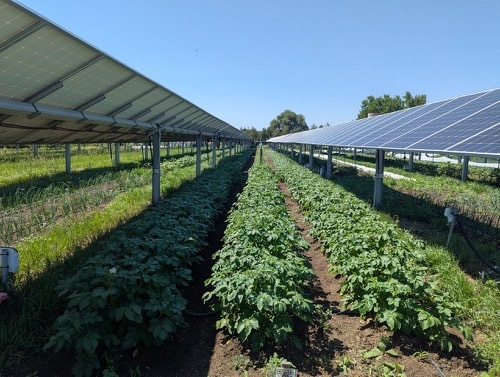
Two crops being farmed at the same time: potatoes and electrons It’s an easier fit for some crops and livestock than others. Lower-growing plants that can do well, or even thrive, without full sun are ideal. Soil temperatures, and therefore water retention, can both be significantly improved by the shade of the panels.
Economic returns are substantial: lettuce revenue can increase by 30%, and tomato revenue can rise by 36% in the Southeast. …Solar panels [in vineyards] in Portugal have reduced irrigation by 30%, improved grape yields by up to 30%, and enhanced quality by 15%.
In partnership with [University of Texas Rio Grande Valley], Fortress Microgrid implemented an agrivoltaic system at the 15-acre Dos Rios Winery, shading grape varieties like Blanc Du Bois and Chardonnay. Solar panels provide power for wine production and tasting rooms, lowering electricity costs while improving grape quality and water efficiency by 20-30%.
One of the objections that some solar projects run into is that they’ll take away land from farming. Agrivoltaics is a wonderful “both/and” response to those concerns. It diversifies income sources for farmers and landowners without making them give up their way of life or livelihood (see also: wind farms and ranchers).
In fact, coming from the other direction, solar farms can provide more agricultural opportunities in some areas, as this article from Wisconsin Public Radio details:
Berry and The Food Group have partnered with US Solar, a Minneapolis solar company, to pilot long-term farming leases for the land inside a solar array. US Solar specializes in community solar projects — arrays that can produce 1 to 5 megawatts of power and cover 8 to 50 acres of land. The project’s emerging farmers get to grow their food crops under the solar panels and in the 20 feet between rows for free.
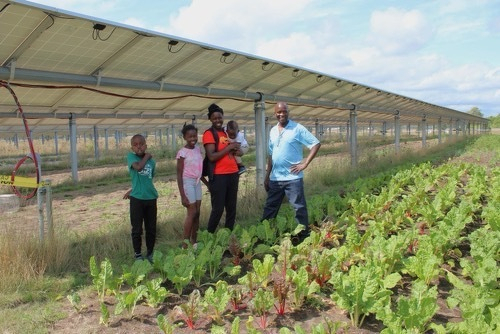
Farmers working with The Food Group, a Minnesota-based nonprofit, are growing organic food at a solar field north of Minneapolis Now, not every solar farm is going to offer use of the land for free. There were upfront costs to ensure “farmers have access to water and electricity, appropriate insurance for their new circumstances, and [allocated] plots”. But for this pilot, US Solar is getting tangible benefits on top of the favorable public relations coverage:
Since the land is being farmed, the solar company doesn’t have to pay to mow what would otherwise be grass. With farmers coming to the site regularly, US Solar has extra eyes on its infrastructure. Berry said the nonprofit’s farmers have notified the company when the panels aren’t rotating as they should and when weather caused damage.
And it’s not only the crops and panel owners who benefit. Research shows that conditions for the people working the farm are also significantly improved:
In her four years of fieldwork on farms like these, often during brutal Arizona summers, Neesham-McTiernan noticed a pattern: Researchers and farmworkers alike would strategically plan to work in the panels’ shade during the hottest hours.
“It just seemed to be something that people in these systems were doing, but nobody in the research area was talking about it,” she said. That struck her as odd, as farmworkers are 35 times more likely to die from heat-related illness than non-agricultural workers. With climate change pushing that figure higher, making any tool to reduce heat stress would be increasingly valuable.
…The biggest reported perk, by far, was shade. One worker, Neesham-McTiernan said, confessed they found it hard to imagine ever going back to work on traditional full-sun farms — where, they added, their favorite crops had always been tomatoes, because of the shade the tall plants offered.
…Shade keeps drinking water cool too, the workers noted — a crucial benefit, given water’s role in mitigating heat stress. “They can pop their bottles under the panels and they stay cool all day,” Neesham-McTiernan said, “rather than it being, as one of the farmworkers described it, like drinking tea.”
35 times more likely to die! That seems like a worthwhile problem to address!
Humans aren’t the only ones that appreciate shade on a hot, sunny farm. Livestock are also a great match for the multiple wins of dual-use. Especially sheep, which are small enough to not bump into panels (vs. cattle), and not active enough to jump up on them (vs. goats).
“These solar companies have created hundreds of thousands of acres that need to be managed across the country. And they need land management and vegetation management, and solar grazers are perfect for that,” said Stacie Peterson, executive director of the American Solar Grazing Association, an organization working to connect solar developers with shepherds.
There’s lots more about agrivoltaics than I covered in this brief introduction. And there are some concerns to figure out (some studies show higher runoff from fields like this, for example, which hardly seems like an insurmountable issue). Ultimately, though, this is another area of renewables that’s both clearly valuable right now, and also easy to imagine rapidly improving over the coming years. Exciting!

It's high time to go solar