-
The Hill: Reconciliation bill subsidizes fossil fuels by $3.5B each year, Democratic report finds
The report only looks at provisions that specifically help the fossil fuel industry and does not include general corporate tax cuts that are likely to bolster those firms as well as others
-
The Guardian, with some cool pictures and full shade: Donald Trump insists there are no wind farms in China. Here are 20 of them – in pictures
The US president has made the easily debunked claim that there are no wind farms in China
-
European nations reinforce wind power commitment with 100 GW pledge
“We are standing up for our national interest by driving for clean energy, which can get the UK off the fossil fuel rollercoaster and give us energy sovereignty and abundance,” said British energy minister Ed Miliband
-
The Trump Energy Crisis
The miracle of our time is the availability and affordability of electricity from the sun (and wind, and batteries). That may sound hyperbolic, but I really think it’s true. Like it or not, humanity in the twenty-first century requires a lot of energy to support its lifestyle. We got here mostly by burning stuff of one kind or another, with pretty obviously bad impacts on air quality. There’s been some advancement in cleaning that up, but then there’s climate change. Less obvious yet way worse, and the advancements on “cleaning that up” have been woefully slow.
So we need a way to generate a bunch of electricity quickly & cleanly. We could hope for a sci-fi silver bullet, like nuclear fusion, or we could focus on the known, existing, and immediately deployable technologies we have: solar, and wind, and batteries. These have always been cleaner, more independent, and created good jobs. The miracle of our time is that now they’re cheaper, not only to build, but also - especially! - to run in the long term. You don’t need to ship sunlight (or wind) from halfway across the planet, or refine it, or distribute it, or clean up spills of it. The whole energy sector is now as close to a no-brainer as you can get. Yet somehow, the current U.S. administration is doing everything it can to obstruct things.
Almost a year ago, President Donald Trump declared that the United States was experiencing an “energy emergency.” At the time, the U.S. was beating national and world-historical records for oil and gas production, as well as for wind and solar generation. But since then, the threat of an energy emergency really has emerged, in large part thanks to Trump’s own interventions in the power sector.
The Trump administration has blocked construction of renewable power sources, rescinded billions of dollars allocated by Congress to expand the grid and clean energy, and helped pass a law that vaporized federal tax credits for wind and solar projects.
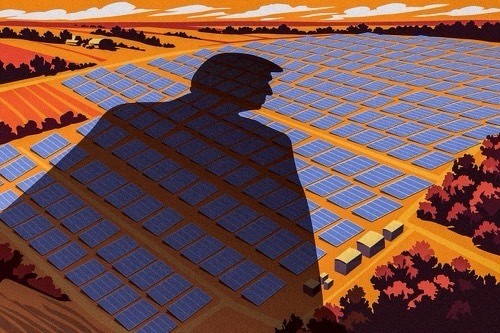
This fucking guy casts his oily shadow over just about everything now. Solar farms are no exception I mean, you have to hand it to the guy, he really can bring problems to life. From rampant corruption in Washington D.C. (aka “the swamp”), to America’s weaker standing on the world stage, to energy emergencies, he’s forever complaining about big problems just before he creates or seriously exacerbates them. On the energy front, that same Canary Media article goes on to list some of the specific actions Trump has taken to manifest this particular crisis:
-
Halting the five offshore wind projects under construction as of December, after unsuccessfully trying to stop two of them earlier last year.
-
Blocking new federal permits for wind farms, a step that a court ruled was unconstitutional.
-
Requiring wind or solar developments on federal lands to obtain a personal sign-off from Interior Secretary Doug Burgum; only one plant has been granted permission by the administration.
-
Canceling final approval for what would have been the nation’s largest solar farm, a 6.2-gigawatt behemoth in the Nevada desert.
-
Eliminating tax credits for wind and solar projects that start construction after July 4, 2026.
-
Revoking billions of dollars appropriated by Congress to support solar installations for low-income communities.
-
Canceling billions of dollars allocated by bipartisan legislation for major upgrades to the power grid, such as the Grain Belt Express transmission line.
The injunctions on those offshore wind projects in the first point have been lifted (for now) after lawsuits showed the obvious: they were spurious and illegal. But that third point, about requiring Burgum’s sign-off, is still keeping tons of potential power in limbo:
Over 22 gigawatts of utility-scale wind and solar projects on public lands have been canceled or are held up as a result of the order, according to Wood Mackenzie data and the Interior’s Bureau of Land Management website. That’s enough capacity to power roughly 16.5 million U.S. homes — a significant amount at any point, but especially when the country is clamoring for more low-cost electricity as energy demand and utility bills soar.
“We’re seeing electricity costs go up all around the country, and the cheapest electrons that we can put into the supply side of that equation are all stuck on Secretary Burgum’s desk,” Sen. Martin Heinrich (D-N.M.) told Canary Media.
This isn’t a bunch of starry-eyed hippies with idealistic dreams. This is electricity generation that simply makes so much sense that the solar (and wind, and batteries) industries are making forward strides in spite of these dumb ideological barriers. Take it from the definitely-not-hippies at the Wall Street Journal and JPMorgan Chase:
Pressure on where to garner energy has shifted with the advent of power-hungry AI. Heather Zichal, global head of sustainability at JPMorgan Chase, said renewables “are vital strategic resources in the race to meet growing energy demand and power AI innovation,” adding that solar “is too cheap and too fast to build to ignore.”
Sun-drenched red states such as natural gas-rich Texas are reaping the benefits of solar. According to a report on the U.S. Energy Information Administration’s website posted in October, the Texas electricity grid is increasingly relying on solar and wind. Utility-scale solar generated 50% more electricity in the first nine months of 2025 than in the same period of 2024—nearly four times as much as the same time frame in 2021, the report said.
Texas! Not exactly a bastion of progressive woke-ism, is it? (And that quote focuses on solar; Texas has tons of wind generation, too.)
So here’s solar (and wind, and batteries), ready to be quickly deployed wherever needed to help bring down electricity prices for all of us (and reduce air pollution, and slow climate change, and give us more energy independence). And then here’s this crook: Trump order to keep Michigan power plant open costs taxpayers $113m. That’s the story of an “aging, unneeded” old power plant, that was on the verge of being retired. Yet against all common sense (not to mention any sliver of the pre-MAGA Republican party’s opposition to the meddling of “Big Government”), the Trump administration has ordered it to keep running. Sorry, Michigan! You just have to eat an extra $615,000 per day for no other reason than Trump trying to prop up the coal industry.
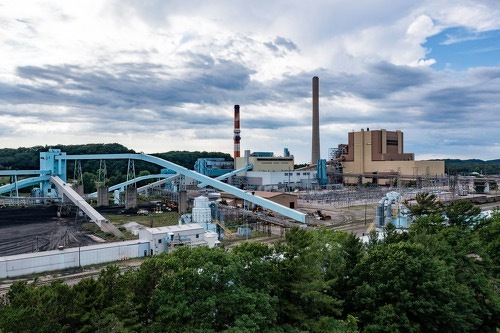
This old coal plant was like, "Just when I thought I was out, they pull me back in!" (Also, please think of the elegant and appealing architecture on display here the next time you hear someone complain that windmills or solar panels are eyesores.) That’s not a weird one-off case in Michigan, either. There’s a similar story in Colorado, where it’s estimated that forcing a broken-down old plant to keep “running for 90 days would cost at least $20 million”. The Trump EPA is, of course, also pitching in to abet this ridiculous scheme, by giving coal plants a free pass on toxic ash disposal:
The move tosses a lifeline to the polluting power plants. If the facilities were barred from dumping ash into unlined pits, they would be forced to close, since they can’t operate if they don’t have a place to dispose of the ash, and the companies say finding alternative locations for disposal would be impossible.
That’s “clean, beautiful coal” for you, as Trump idiotically calls it. Easy for him to say, since he doesn’t have to drink the water that’s contaminated by a devil’s brew of arsenic, molybdenum, cobalt, radium, and god knows what else.
Look, this is classic Trump: pushing bad policies that enrich and empower him and/or his cronies, and to hell with everyone else. But there’s a better, cleaner, and cheaper way. Here’s just one study, for example: Kentuckians could save billions if utilities moved beyond fossil fuels (note that’s billions, with a ‘b’).
“Here in Kentucky, coal was the least-cost way to produce electricity, but as our coal plants age and as the cost of renewable energy continues to fall, that’s simply no longer the case,” Wilmes said. “Continuing to rely on aging, uneconomic power plants simply leads us to less stable, less dependable and higher-cost electricity when compared to the other pathways that are modeled in our report.”
The Biden administration took some great, groundbreaking steps toward accelerating solar (and wind, and batteries). It wasn’t perfect, but it was a good start. Trump feels he has to pit himself against anything Biden was for, and all that fossil-fuel industry campaign money has to be repaid, too. But this particular grift of his is costing all of us, both directly, through higher power bills, and indirectly, through unnecessary air pollution and continuing to pour greenhouse gases into the atmosphere.
I’ll give the final word to Armond Cohen, executive director of the Clean Air Task Force, with a great quote from the first story I linked above:
There is a crisis. It’s like we’re back in the ’70s, but instead of OPEC squeezing us, it’s us squeezing us.
It’s 269 days until Election Day, when we can start putting a stop to some of this nonsense. See you at the polls.
-
-
In case someone else says this dumb thing to you: Trump says the big US winter storm is proof of climate hoax – here’s why he’s wrong
scientists point out that a single winter storm… tells us very little about longer-term, global climate trends. …The world [is] undeniably heating up
-
Case in point on my agrivoltaics post the other day: Solar grazing: ‘triple-win’ for sheep farmers, renewables
a growing number of farmers are discovering the free grazing opportunities offered by some solar panel sites are a toe-hold in an industry where land is often unaffordable/unobtainable
-
Agrivoltaics - Win-Win-Win, So Many Wins
The name “agrivoltaics” - a mashup of agriculture and photovoltaics - may be a little clunky, but the idea is as simple as it is brilliant. It’s the combination of the two uses on the same land. Not just crops, or just solar panels, but both, usually striped across the acres. Like a lot about the solar boom we’re watching blow up, it isn’t a new application, but it’s really catching on. And deservedly so: it’s a win for solar, a win for farming, and a win for land-use, each win with more wins within. So many wins!
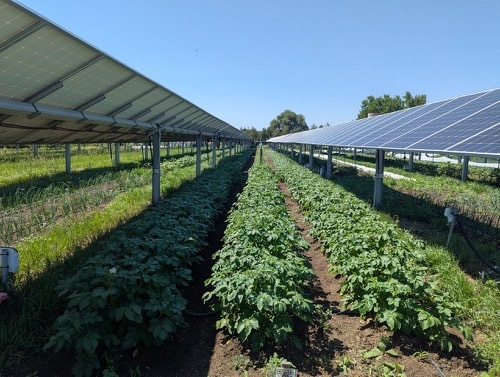
Two crops being farmed at the same time: potatoes and electrons It’s an easier fit for some crops and livestock than others. Lower-growing plants that can do well, or even thrive, without full sun are ideal. Soil temperatures, and therefore water retention, can both be significantly improved by the shade of the panels.
Economic returns are substantial: lettuce revenue can increase by 30%, and tomato revenue can rise by 36% in the Southeast. …Solar panels [in vineyards] in Portugal have reduced irrigation by 30%, improved grape yields by up to 30%, and enhanced quality by 15%.
In partnership with [University of Texas Rio Grande Valley], Fortress Microgrid implemented an agrivoltaic system at the 15-acre Dos Rios Winery, shading grape varieties like Blanc Du Bois and Chardonnay. Solar panels provide power for wine production and tasting rooms, lowering electricity costs while improving grape quality and water efficiency by 20-30%.
One of the objections that some solar projects run into is that they’ll take away land from farming. Agrivoltaics is a wonderful “both/and” response to those concerns. It diversifies income sources for farmers and landowners without making them give up their way of life or livelihood (see also: wind farms and ranchers).
In fact, coming from the other direction, solar farms can provide more agricultural opportunities in some areas, as this article from Wisconsin Public Radio details:
Berry and The Food Group have partnered with US Solar, a Minneapolis solar company, to pilot long-term farming leases for the land inside a solar array. US Solar specializes in community solar projects — arrays that can produce 1 to 5 megawatts of power and cover 8 to 50 acres of land. The project’s emerging farmers get to grow their food crops under the solar panels and in the 20 feet between rows for free.
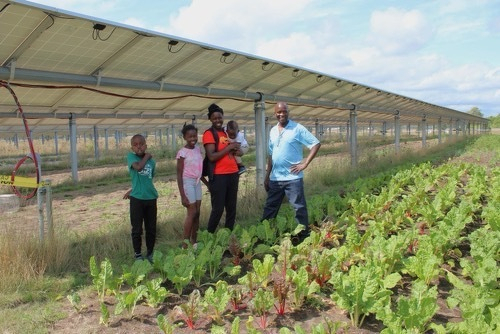
Farmers working with The Food Group, a Minnesota-based nonprofit, are growing organic food at a solar field north of Minneapolis Now, not every solar farm is going to offer use of the land for free. There were upfront costs to ensure “farmers have access to water and electricity, appropriate insurance for their new circumstances, and [allocated] plots”. But for this pilot, US Solar is getting tangible benefits on top of the favorable public relations coverage:
Since the land is being farmed, the solar company doesn’t have to pay to mow what would otherwise be grass. With farmers coming to the site regularly, US Solar has extra eyes on its infrastructure. Berry said the nonprofit’s farmers have notified the company when the panels aren’t rotating as they should and when weather caused damage.
And it’s not only the crops and panel owners who benefit. Research shows that conditions for the people working the farm are also significantly improved:
In her four years of fieldwork on farms like these, often during brutal Arizona summers, Neesham-McTiernan noticed a pattern: Researchers and farmworkers alike would strategically plan to work in the panels’ shade during the hottest hours.
“It just seemed to be something that people in these systems were doing, but nobody in the research area was talking about it,” she said. That struck her as odd, as farmworkers are 35 times more likely to die from heat-related illness than non-agricultural workers. With climate change pushing that figure higher, making any tool to reduce heat stress would be increasingly valuable.
…The biggest reported perk, by far, was shade. One worker, Neesham-McTiernan said, confessed they found it hard to imagine ever going back to work on traditional full-sun farms — where, they added, their favorite crops had always been tomatoes, because of the shade the tall plants offered.
…Shade keeps drinking water cool too, the workers noted — a crucial benefit, given water’s role in mitigating heat stress. “They can pop their bottles under the panels and they stay cool all day,” Neesham-McTiernan said, “rather than it being, as one of the farmworkers described it, like drinking tea.”
35 times more likely to die! That seems like a worthwhile problem to address!
Humans aren’t the only ones that appreciate shade on a hot, sunny farm. Livestock are also a great match for the multiple wins of dual-use. Especially sheep, which are small enough to not bump into panels (vs. cattle), and not active enough to jump up on them (vs. goats).
“These solar companies have created hundreds of thousands of acres that need to be managed across the country. And they need land management and vegetation management, and solar grazers are perfect for that,” said Stacie Peterson, executive director of the American Solar Grazing Association, an organization working to connect solar developers with shepherds.
There’s lots more about agrivoltaics than I covered in this brief introduction. And there are some concerns to figure out (some studies show higher runoff from fields like this, for example, which hardly seems like an insurmountable issue). Ultimately, though, this is another area of renewables that’s both clearly valuable right now, and also easy to imagine rapidly improving over the coming years. Exciting!
-
Good news (again/for now): Judge reverses Trump order halting Revolution Wind
Judge Lamberth said the government had failed to explain why the new information warranted a halt to construction, calling it an “unreasonable and seemingly unjustified” change in position.
-
There are a bunch of these dumb & purely political orders, all over the country, as the Trump admin desperately tries to prop up fossil fuels. This coal plant in Colorado isn’t even running (it broke down 2 weeks before the order). Gov. Polis is right: it’s ludicrous
-
Lifesaving Solar
The number one advantage of solar (and batteries, and wind) over fossil fuels, especially in 2026, is the reduction in greenhouse gasses. That’s probably advantage number two, and three, four, and five, to be honest. Climate change is a catastrophe, and it’s happening right now. The sooner we stop adding CO2 (and methane, etc.) to the atmosphere, the better.
But that huge imperative can overshadow other vital improvements to our lives that will come via the clean energy transition. A big one is eliminating the plain ol' air pollution caused by burning the fuels of the past. Particulates, soot, toxic who-knows-what; all that shit. All the electricity that comes from coal plants, all the road miles powered by internal combustion engines, and all the buildings heated by gas furnaces - they’re literally killing us.

Breathing air like this: at least as bad for you as you'd expect According to the latest State of Global Air report, nearly 8 million deaths in 2023 were attributed to air pollution. Eight million people! And that’s per year!
The report goes on:
More than 90% of air pollution deaths occur in low- and middle-income countries. Countries in South Asia and most of Africa see the double burden from both outdoor and household air pollution. Death rates in these regions are often 8-10 times higher than high-income countries.
When considering diseases, the differences are similarly large. Globally, air pollution contributes to 25% of deaths due to ischemic heart disease. In most of Africa and South Asia, this number can be as high as 35% while in high-income countries, only about 7% of heart disease deaths are due to air pollution.
So congratulations to me, and probably you, for being lucky enough to live in a “high-income country” like the US. But don’t take too much comfort from that “only” number; seven percent is still a lot! It could be less than that! It could be zero! All we have to do is stop unnecessarily burning shit to power our lives.
It’s not just heart disease, either.
Exposure to air pollution has been linked with neurodegenerative diseases, such as Alzheimer’s disease and other forms of dementia. In 2023, more than 600,000 dementia deaths and 11.6 million healthy years of life lost were attributable to air pollution, with 92% of deaths occurring amongst older people (70+ years).
To repeat that: more than half a million people died of dementia in 2023 because of air pollution. Next time the monster in the White House includes the phrase “beautiful clean coal” in one of his own demented rants, think of the people in your life suffering from or already lost to afflictions like these.
So, as with climate change, there’s a clear moral distinction here. Species shouldn’t be driven to extinction, and millions of people shouldn’t be displaced due to the rapidly changing climate; likewise, people shouldn’t have to die of heart disease or dementia so that we can run our heat and A/C, drive around, and simply live our lives. That’s just wrong.
Yet there’s another argument we can use, when we must: the old, dirty ways of powering our lives are also more expensive. Relocating people displaced from flooded coastal areas will be hella expensive. Property insurance is already hella expensive (where you can still get coverage, that is) and getting more so. And we all know how expensive medical care is, with prices that will only continue to balloon.
Which brings me to this study that shows that, in the big picture, replacing dirty fuels with solar power actually saves real money in areas apart from direct power generation (emphasis mine):
The research team analyzed data from between 2014 and 2022, focusing on community health, air quality levels, the climate, and economic impact. They found that solar panels prevented 595 premature deaths that would typically be caused by poor air quality that stems from fossil fuels. When looking at 2020 in particular , the research team found that the monetary benefits were worth about half the cost of the solar panels themselves.
Put that in your payback-period pipe and smoke it! (Don’t, actually; it would only create more air pollution.)
The research team went a step further in evaluating the impact of solar panels on adjoining states, not just the states within the U.S. that imported the panels. There was a spread in the benefits, meaning that the entire region benefitted from the cleaner air because of the way air travels across the country. In the same way air pollution from wildfire smoke or power plants can move across state and country lines, so can cleaner air.
A key point of this study is that importing solar panels – even from big bad scary China – is even more worthwhile than it looks at first, but trade restrictions and a domestic solar industry are topics for another post.
That aside, the sad reality is that many of the organizations making decisions about clean power won’t even think about these impacts. Pollution is the textbook example of an “externality”, after all. The board of BigPowerCo, deciding between yet another dirty, old-fashioned gas-powered “peaker” plant, versus meeting the same demand with solar (and batteries, and wind), won’t weigh how many grandmas and grandpas will or won’t live to meet all their grandkids.
But they should consider that. Companies killing people (and the climate) by burning fossil fuels have gotten away without accounting for their externalities for a really, really long time. There are better choices, now. They’ve even become less expensive! There’s no excuse anymore.

The study cited above is from 2023, but the dangers of dirty air have been obvious since the nineteenth century. Here's coal personified, neither "clean" nor "beautiful", unleashing a demon to blight the city below with asthma, bronchitis, pneumonia, and pleurisy -
We Need Wind Power, Especially in Winter
The day after a severe winter storm hit the midwestern and northeastern US, leaving tens of thousands of people without power, is as good a day as any to underline the belligerent stupidity of Trump’s assault on the wind power industry. Aging grids, energy-hogging data centers sprouting up like dandelions, power costs continually climbing, and here’s this fool doing everything he can to undermine a key source of clean energy.
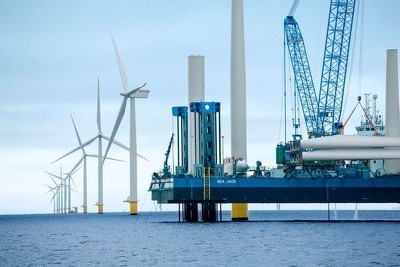 As Canary Media reports in an article last month titled Feel the cold? Offshore wind alleviates grid woes in winter, study says, the power generated by the wind turbines that Trump dislikes are especially useful this time of year:
Along the Northeast and mid-Atlantic regions, offshore wind can play a critical role in keeping the lights on year-round, especially through the winter, according to a study published this month… offshore wind is well suited to “meeting the moment,” in part because gas plants are reliable in the summer but can buckle under winter weather, according to the study. Ocean winds in the Northeast are at their strongest and steadiest in winter months, making turbines there a way to boost the reliability of power grids connected to underperforming gas plants.
The article goes on to say:
The periods in which offshore wind performs best also align with the time of increasing grid strain: winter mornings and evenings, when people tend to crank up the heat.
So generating power from the wind in the northeast is a good fit, on both a seasonal and a daily basis. And these are the projects that are being capriciously cancelled by the fossil fuel superfans that Big Oil helped get elected to run this country. Projects like Revolution Wind, the big wind farm project off the coast of Rhode Island, which Trump tried to kill even though it was 80% complete. Thankfully construction has resumed (for now), after a federal judge found that the stoppage was indeed as arbitrary as it seemed.
Susan Muller, a senior energy analyst at the Union of Concerned Scientists, told Canary Media that if Revolution Wind were killed, the impact would be most acutely felt in winter months. That’s when the region’s limited supply of fossil gas is stretched even thinner, since the fuel is used for both building heating and power generation.
Losing Revolution Wind’s electricity entirely would have cost New England consumers about $500 million a year, according to Abe Silverman, a research scholar at Johns Hopkins University.
Look, wind isn’t quite as lovely and scalable as solar. These are huge projects, with all the attendant costs, timelines, and complications. But as with solar, once they’re online the fuel is free, forever. Exxon Mobil can’t make any money from that – in fact, it cuts right into their business – so they don’t like it. Just like all of Trump’s rich cronies, they don’t care if the American people get shafted for half a billion dollars. For Big Oil, that kind of money is just the going rate to buy politicians in the Trump era.
-
Great story – with great pictures – from @Science.org, who named the surge in renewable power their 2025 Breakthrough of the Year:
China’s solar power generation grew more than 20-fold over the past decade, and its solar and wind farms now have enough capacity to power the entire United States.
-
Which country got the largest share of its electricity from solar in 2024? A balmy island nation, a country with swaths of blistering desert, or at least somewhere notoriously hot and sunny? Nope - per @canarymedia.com the global leader was Hungary 🌞
-
This is what’s known in the business as, “bullshit”: Trump officials halt offshore wind-farm projects over ‘national security risks’. It’s a disgusting & arbitrary overreach that will only drive up energy prices (and deadly emissions, of course)
-
The Power of Scalable Battery Power
One of the killer features of renewables is that they’re modular, scalable, and can be fit in right where they’re needed. Less so for wind turbines, perhaps, but the innovation happening with batteries is showing this at virtually every level. At the smallest scale – personal, even – electricity can be stored in portable solar generators (I just got a small one of these to keep my phone, laptop, & more running; $300 and free power from the sun for years to come). On the bigger end are utility-scale “BESS” (battery energy storage systems), which add resiliency at the electrical grid level.
The biggest of those BESS projects can be subject to the delays inherent in any big construction effort: bureaucracy, complexity, NIMBYism, fear mongering about their supposed dangers (a topic for another post), cost and schedule overruns, etc. That’s where the killer feature of scalability comes in: these solutions don’t all have to be so big. As in this story from Canary Media: Small but mighty grid batteries take root in Virginia amid energy crunch.
The 10-megawatt, four-hour batteries, one each in the tiny towns of Exmore and Tasley, represent this “missing middle,” said Chris Cucci, chief strategy officer for Climate First Bank, which provided $32 million in financing for the two units. Batteries are a critical technology in the shift to renewable energy because they can store wind and solar electrons and discharge them when the sun isn’t shining or breezes die down.

When it comes to energy storage, “we need volume, but we also need speed to market,” Cucci said. “The big projects do move the needle, but they can take a few years to come online.” And in rural Virginia, batteries paired with enormous solar arrays — which can span 100-plus acres — face increasing headwinds, in part over the concern that they’re displacing farmland.
The Exmore and Tasley systems, by contrast, took about a year to permit, broke ground in April, and came online this fall, Cucci said. Sited at two substations 10 miles apart, the batteries occupy about 1 acre each.
These “small but mighty” batteries can fill the crucial gap when production from solar or wind dips, as well as when demand spikes. That kind of capacity planning is crucial for utilities, to protect their users in the event of severe weather, summer heat as well as winter storms. A popular solution to these eventualities in the past has been gas-powered “peaker” plants. But in addition to the power they provide being more expensive, there are other problems with those.
“Peaker plants are smaller power plants that are in closer proximity to the populations they serve, and [they] are traditionally very dirty,” Cucci said. “They’re also economically inefficient to run. Battery storage is cleaner, more efficient, and easier to deploy.”
Gas peaker plants are wasteful partly because of all the energy required to drill and transport the fuel that fires them, said Nate Benforado, senior attorney at the Southern Environmental Law Center, a nonprofit legal advocacy group.
“Then you get [the fuel] to your power plant, and you have to burn it,” Benforado said. “And guess what? You only capture a relatively small portion of the potential energy in those carbon molecules.”
Single-cycle peaker plants, the most common type, can go from zero to full power in minutes, much like a jet engine. Their efficiency ranges between 33% and 43%.
The other good news for these grid battery installations is that federal tax credits for them managed to survive Trump’s “big beautiful bill”, and are still in effect. This is a clean, proven, and inexpensive technology that can be – no, should be – deployed wherever needed.
-
Good news: US judge strikes down Trump order blocking wind energy projects
A federal judge on Monday struck down Donald Trump’s order blocking wind energy projects, saying the effort to halt leasing of windfarms on federal lands and waters was “arbitrary and capricious” and violated US law
-
We Don't Have Time for Fusion
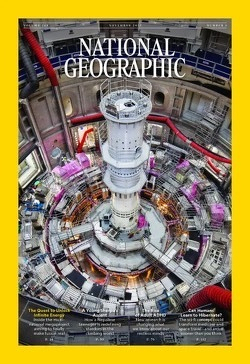 One of the key arguments here at Solar Noon is we don’t have time for that shit, referring to the nonsense that distracts us from the solar future that’s already within our grasp today. Here’s a perfect example: a splashy National Geographic cover story on the giant fusion project “ITER”. The online version of the article, “Inside the long-shot megaproject that aims to solve our energy worries forever” is locked for subscribers (like me, currently), but read on and you won’t miss much. You’re not missing much regardless.
Fusion is that other kind of nuclear reaction, the one that generates energy by atoms smashing together, as opposed to fission, the one that splits them. Fission is what’s used in the nuclear power plants of the past: Chernobyl, Three Mile Island, and Homer Simpson’s Springfield. The magical unicorn promise of fusion is that it has less radioactive waste (but not none!) and can theoretically provide a lot more power.
The key word in that last sentence is theoretically. A lot of smart folks who know about such things aren’t too keen on the whole idea:
Daniel Jassby, who worked at the Princeton Plasma Physics Lab for 25 years, wrote after his retirement that a fusion plant would be too convoluted, requiring endless maintenance, and “cause more problems than it would solve.” The late Lawrence Lidsky, an associate director of MIT’s fusion center and founding editor of the Journal of Fusion Energy, declared after a long career that fusion power is a fantasy, noting that it’s widely regarded as “the hardest scientific and technical problem ever tackled.” Walter Marshall, former chairman of the United Kingdom Atomic Energy Authority, reportedly said that “fusion is an idea with infinite possibility and zero chance of success.”
The entire framing of this article is insane. It’s practically a manifesto of how impractical, complicated, expensive, misguided and crazy this whole project is, but cast in the heroic light of amazement and wonder. Which I suppose is on brand for National Geographic: audacious and amazing and impractical stuff, pictures of rare wildlife, etc. Another article in the same issue is about an 18-year-old who’s climbed the world’s 14 tallest peaks. But the subtitle of this ITER article is, The race is on to harness the near-infinite power of nuclear fusion—by building a star on Earth. And scientists are closer than you might think. Scientists, you learn after reading the whole thing, are actually farther away than you think:
The strange truth of ITER, however, is that it will never produce power. The machine is strictly an experiment to prove that all the steps are achievable. Steam turbines, old technology well understood, will presumably be installed in later generations of fusion plants that will be built all over the world. This step could easily be more than 50 years away.
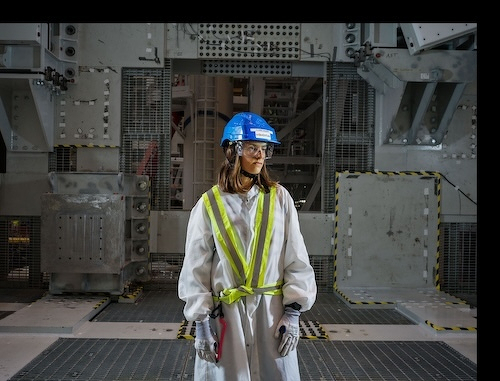
An ITER worker, having just learned that the goal of decades of intricate work and billions of dollars is to run the thing for 400 seconds, if they're lucky Realize, dear reader, that this effort started in 1958. Construction of the facility featured in this article didn’t even start until 2007. In 2022 they made headlines around the world for a huge milestone: installing one – one! of nine! – of the central “vacuum vessel modules” that’s essential to part of the design. Yet that was so badly botched that they had to tear it all out and start over, a mistake that cost them years. At the cost of billions of dollars, of course - though the thing’s been dragging on so long that nobody’s really sure how much total money it’s burned yet (the US Dept. of Energy estimates $65 billion, and counting).
That’s all public money, from countries all over the world (the international cooperation behind this boondoggle is actually a pretty nice story, if surely sanitized in Nat Geo style), but there are also a bunch of private companies trying to crack this nut. Let’s stop pouring taxpayer money into the 270-million degree plasma that will never exist inside this “most complex machine humans have ever attempted to build”. And let’s stop looking to these ‘so crazy it just might work’ long shots.
Fusion, observers like to say, is 20 years away—and always will be.
Meanwhile, as the world outside of Saint-Paul-lès-Durance, France continues to burn, we have the technology right now, today, this minute, to replace fossil fuels with clean energy. Those technologies – solar panels, wind turbines, and battery storage – are all advancing at a fantastic pace, too. Their research and deployment could absolutely use billions of public dollars, and they will start putting out the climate fires immediately. They’re also easily distributable and installable all over the world. Even if there were some magic breakthrough with nuclear fusion and someone figured out how to build these “most complex machines humans have ever attempted” today, how soon do you suppose one of those reactors would pop up in Africa, or Southeast Asia, or Mississippi? It’s ludicrous to suggest this
technologyfantasy has the slightest bearing on “solving our energy worries”, so let’s just not, okay? -
Great news from The Guardian: law changes could soon bring balcony solar to millions across US
Balcony solar panels are now widespread in countries such as Germany – where more than 1m homes have them – but have until now been stymied in the US by state regulations. This is set to change, with lawmakers in New York and Pennsylvania filing bills to join Utah in adopting permission for the panels, with Vermont, Maryland and New Hampshire set to follow suit soon.

It's high time to go solar